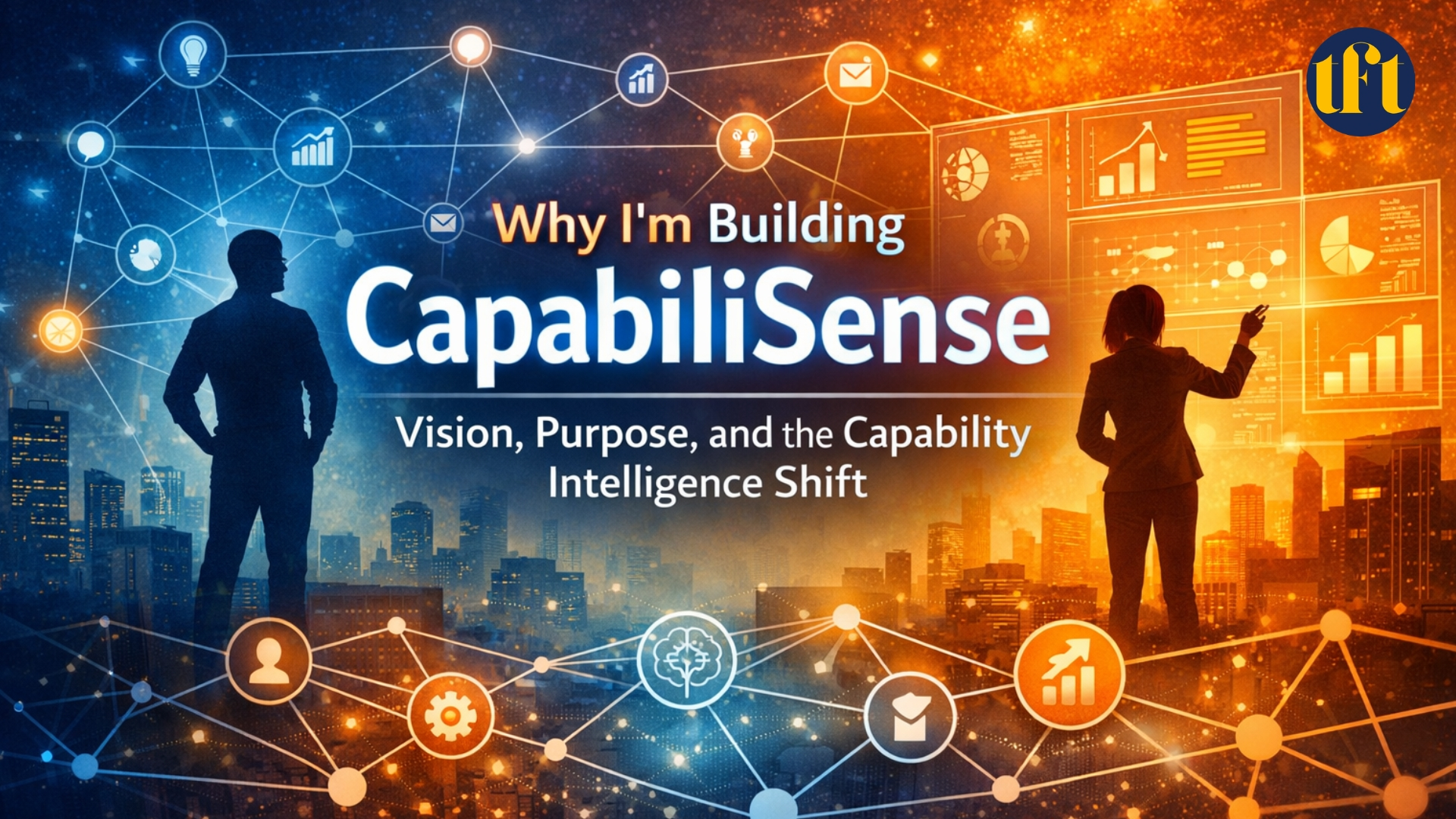

In 2009, I watched a team spend an entire meeting debating a dashboard that looked brilliant and changed nothing. The charts were polished, the numbers were accurate, and the decisions still felt like educated guesses. That was the moment I started asking a question that still drives me today, and it’s the heart of why Im building capabilisense.
Years later, the pattern kept repeating across startups, nonprofits, and enterprises. People were assessed, teams were benchmarked, and digital transformations were announced, yet the same problems stayed put: uncertainty, capability gaps, and talent stuck in misaligned roles. We had data everywhere, but direction nowhere.
In this article, I’ll share the founder story behind the idea, what “capability” really means, and why a capability-first approach changes everything. You’ll see how Capabilisense is designed to transform information into actionable insight, who it’s for, and what real-world impact it can create. If the mission resonates, you’ll also learn how to join the community and build this shift together.
The Problem I Noticed: Data Everywhere, Direction Nowhere
Most organizations do not have a data problem. They have a direction problem.
We collect performance metrics, engagement scores, skills inventories, competency checklists, and learning data. But when leaders ask, “What should we do next?” The answer is often fuzzy. That is data overload without decision intelligence.
I saw teams drowning in skills signal vs noise. They had “visibility” into everything except the one thing that mattered: what a person or team could reliably do next, in context, and how to grow it.

The Repeating Failure Pattern in Modern Organizations
The failure pattern is painfully consistent. First, a transformation initiative launches, usually with ambitious goals and a tight timeline. Next, leaders map roles, audit skills, and buy platforms that promise workforce transformation. Then reality hits: execution gap, change resistance, and talent misallocation because the system cannot explain what to do with the information.
In nearly every case, the root issue was not effort or intelligence. It was missing a layer: a capability framework that connects people, work, and growth in a way that is measurable, actionable, and human-centered.
The Real-World Gap Capabilisense Addresses
Capabilisense is built for the space between “we have data” and “we have clarity.”
When an organization cannot see capability gaps, it cannot prioritize learning pathways or redesign teams confidently. When individuals do not understand their strengths beyond job titles, they chase static job ladders instead of building adaptability intelligence. When leaders cannot translate AI era disruption into capability-driven transformation, digital initiatives fail, and morale drops.
The gap is this: we are measuring people, but we are not mapping potential intelligence in a way that drives better decisions and better lives.
What “Capability” Really Means and Why It’s Often Misunderstood
Capability is not a job title, a personality label, or a test score. Capability is the repeatable ability to produce outcomes in a real context, using skills and judgment, under constraints.
Many platforms confuse skills and capabilities. Skills are ingredients. Capability is the meal you can reliably cook for different guests, in different kitchens, with different time limits.
This is why capability measurement matters. It turns “I have skills” into “I can deliver outcomes,” and it turns “we need training” into “we need a specific growth path for a specific capability gap.”
Human Potential Beyond Job Titles
Most people are larger than their resume. I have met project managers who were natural systems thinkers, analysts who were quietly exceptional coaches, and frontline employees with leadership potential that never appeared on a competency grid. Traditional role-based systems often trap people in a narrow story about who they are.
Capabilisense is designed to surface hidden strengths and reveal how human capability analytics can support real mobility, not just lateral moves on an org chart.
Why Adaptability Matters More Than Ever
The future of work rewards people who can learn, unlearn, and recombine strengths quickly. AI is accelerating change, not reducing it. Adaptability is a capability, not a personality trait. It is developed through feedback loops, exposure to new contexts, and a clear view of what to practice next. That is why a capability model must be dynamic, not a one-time evaluation.
The Limits of Traditional Assessments and Why They No Longer Work
Traditional assessments can be useful, but they are often used as if they are complete.
Career tests and personality tests’ limitations show up when results are treated as destiny. Skills assessments can be helpful, but test-based evaluation misses context and real-world alignment. Checkbox competency models may create consistency, yet they often reduce people to static scoring models.
The biggest issue is that most systems are built for evaluation, not empowerment. They compare people to a benchmark and stop there.
Moving Beyond Traditional Assessment
The question should not be “How do you rank?” The question should be “What can you do in your environment, and what would make you stronger next month?”
Many assessment tools are context-free benchmarking machines. They can be biased assessments, or they can simply be incomplete because they ignore constraints, culture, and real work. In a fast-changing world, a one-time evaluation becomes outdated quickly.
The Shift From Evaluation to Empowerment
Empowerment means turning insight into action.
A capability assessment should lead to personalized recommendations, progress tracking, and coaching and development that fit the person’s situation. The output should be a map, not a label. It should support strengths-based development and lifelong learning, not anxiety and ranking systems.
| Dimension | Traditional Assessments | Capability Intelligence (Capabilisense approach) |
| Primary Goal | Evaluate and score | Enable growth and better decisions |
| Lens | Comparison to benchmarks | Context over comparison |
| Time Horizon | One-time snapshot | Continuous feedback loops |
| Output | Static results and labels | Actionable insights and personalized growth paths |
| Focus | Performance vs potential (often performance-heavy) | Potential over position |
| Fit For Transformation | Often disconnected from execution | Built for capability-driven transformation |
| Trust | Can feel opaque or judgmental | Transparency, explainable insights, human-in-the-loop |
The Spark of an Idea: The Origin Story Behind Capabilisense
The origin story did not come from a single “aha” moment. It came from repeated frustration.
I kept seeing leaders invest in tools that produced reports but did not produce momentum. I kept hearing employees say they felt unseen, misaligned, or stuck. I watched high-potential employees burn out because their growth was treated as an annual event instead of a living process.
Eventually, I wrote a simple line in my notes: “We do not need more data. We need capability diagnostics that turn noise into direction.”
The Personal Connection: The Human Element Behind the Technology
This is not just a passion project. It is personal. I have been the person who looked competent on paper while feeling underutilized in reality. I have also been the manager who struggled to place someone correctly because I lacked a shared language for capability alignment. And I’ve been a builder who knows the right tool can change a person’s trajectory.
Capabilisense is my attempt to create that shared language, while keeping dignity at the center. Human-centered design is not a feature. It is the foundation.
The Startup Founder’s Dilemma
Every mission-driven startup faces a hard choice: build something impressive, or build something useful. Impressive is easy to market. Useful is harder because it demands truth, iteration, and restraint. It forces you to say no to flashy complexity and yes to clarity over complexity.
The founder’s intent behind Capabilisense is to build decision support that respects people. That means privacy-first design, bias reduction where possible, and trust and accountability in how recommendations are made.
Source: Google Books
The Core Idea Behind Capabilisense: A Capability-First Approach
A capability-first approach starts with outcomes, not labels. Instead of asking, “What role are you in?” it asks, “What outcomes do you repeatedly create, and what conditions help or hinder you?” Instead of forcing everyone into a generic capability taxonomy, it uses a capability framework that can adapt to context. Instead of static scoring, it uses progress signals, measurement, and iteration.
Why a Capability-First Approach Changes Everything
When capability becomes the unit of understanding, you can redesign growth with precision. Individuals can build a personal capability model. Teams can plan coverage and reduce blind spots. Organizations can align reskilling and upskilling to strategy instead of trends.
This shift also reduces talent misallocation. It helps leaders see who can stretch into what, and what support makes it realistic.
Context Over Comparison
Comparison makes people defensive. Context makes people curious.
Capabilisense is designed to interpret capability in the environment where it matters. That includes tools, constraints, collaboration patterns, and the kind of decisions a person faces. Context creates explainable insights that feel fair and useful.
Potential Over Position
Position is where you are. Potential is what you can become.
A capability graph can show adjacent possibilities that job ladders miss. It can highlight hidden strengths that are not visible in performance reviews. It can also identify capability gaps early, before they become costly.
Growth Over Static Evaluation
Growth is not a yearly event.
Capabilisense is built around growth mindset principles, learning pathways, and feedback loops that keep people moving. It treats capability maturity as something you develop through guided practice, not something you either “have” or “lack.”
How Capabilisense Would Work
At a high level, Capabilisense aims to connect four things: capabilities, context, work, and growth actions.
It would combine capability mapping with a recommendations engine that translates insight into next steps. It would support individuals and teams without turning the experience into surveillance. The goal is workforce visibility that is empowering, not controlling.
Intelligent Capability Mapping
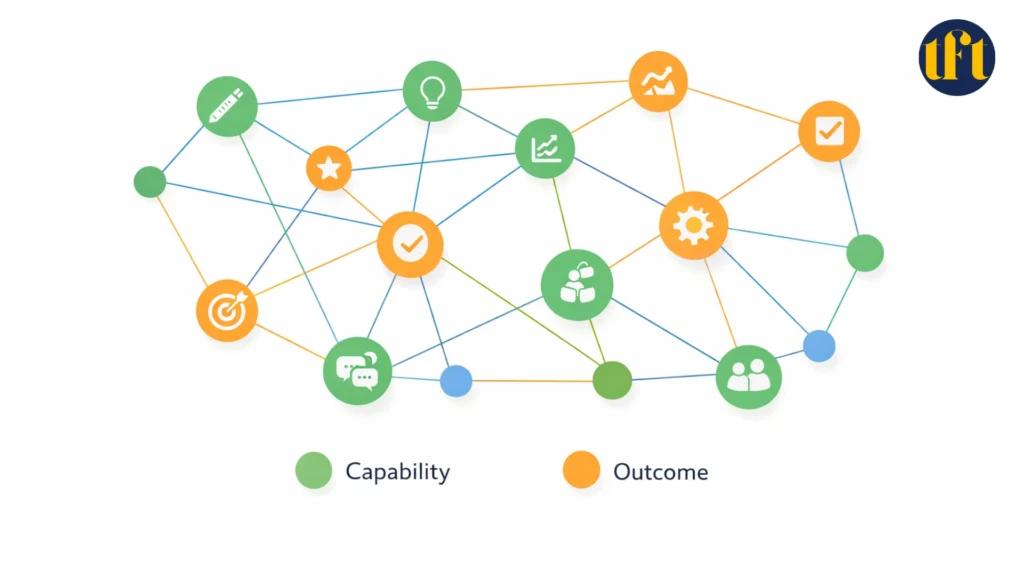
The system would build a capability graph that reflects what people do, how they do it, and what outcomes they produce.
This is not a simplistic list of skills and capabilities. It is an evolving capability taxonomy with links to evidence signals, reflection prompts, and real work artifacts when available. The mapping is meant to be transparent, so users can understand why a capability is suggested.
Personalized Growth Paths
Once capabilities are mapped, the system will propose personalized growth paths.
These would include learning pathways, stretch assignments, micro-project ideas, coaching prompts, and resource recommendations. The core is gap analysis that prioritizes what matters, not everything that is missing.
Real-World Alignment
Capabilisense is designed to anchor recommendations to real-world alignment.
If a team is moving toward automation, it should highlight capabilities related to change readiness and systems thinking. If a leader needs better cross-functional execution, they should propose capability alignment actions that improve collaboration and decision-making, not just more training.
Unlocking Hidden Strengths
People often underestimate themselves because they lack a mirror.
Capabilisense would help users discover strengths they already demonstrate, then translate those strengths into future opportunities. This is where strengths discovery becomes practical and motivating, not just inspirational.
The Technology Behind the Dream
Technology matters, but only when it serves a human purpose.
Capabilisense is not built to replace managers, coaches, or human judgment. It is built to make growth more visible and less random. It should act like a compass: helpful, explainable, and humble.
Why we need Capabilisense for the AI Era
In the AI era, change is faster than traditional systems can track.
Organizations adopt tools, but adoption is not transformation readiness. AI changes workflows, decision speed, and skill demand. Without capability intelligence, leaders cannot see what must be developed, what can be redeployed, and where the transformation gap will appear.
Addressing Digital and AI Transformation Failure
Digital and AI transformation failure often comes down to human capability misalignment.
The technology may work, but the organization cannot operate it, govern it, or adapt around it. Capability-driven transformation focuses on what people must be able to do, not just what tools they must implement. Capabilisense aims to surface those needs early and translate them into action.
How Capabilisense Thinks Differently
Capabilisense is designed around explainable insights and human-in-the-loop decision-making.
It should prioritize transparency, not black-box scoring. It should be privacy-first, so individuals feel safe exploring growth. It should reduce bias by focusing on outcomes, context, and evidence, while allowing users to challenge and refine what the system believes.
Who Capabilisense Is Built For
Capabilisense is built for people who want clarity, not just information.
It is for anyone tired of static scoring models and generic development plans. It is for those who believe capability measurement should lead to empowerment over evaluation.
Individuals
For individuals, the value is a clearer story about strengths, gaps, and next steps.
It supports career development planning without locking someone into a single identity. It offers personalized recommendations that help users build adaptability and confidence.
Teams
Teams need team capability planning, not just role descriptions.
Capabilisense can help teams see coverage, bottlenecks, and capability gaps that cause delays. It can also guide learning and development in a way that improves real execution.
Leaders
Leaders need decision intelligence for people strategy.
Capabilisense aims to help leaders deploy talent more effectively, develop high-potential employees responsibly, and reduce the cost of misaligned roles and skills. It provides a language for growth conversations that is specific and actionable.
Organizations
Organizations need workforce transformation that is measurable and humane.
Capabilisense is designed to support HR and talent leaders, People Ops, and L&D teams with capability diagnostics, progress tracking, and alignment to strategy. It should also support organizational design by making capability alignment visible.
Practical Applications Across Growth Stages
Capabilisense is not just for mature enterprises.
Early-stage startups can use it to place people where they thrive, especially when everyone wears multiple hats. Mid-size organizations can use it to scale leadership development and reduce talent bottlenecks. Enterprises can use it to align reskilling and upskilling to strategic shifts and reduce transformation failure.
Across stages, the throughline is the same: clarity over complexity, and action over noise.
Examples of Capabilisense in Action
Here are a few realistic scenarios that show how capability intelligence could work.
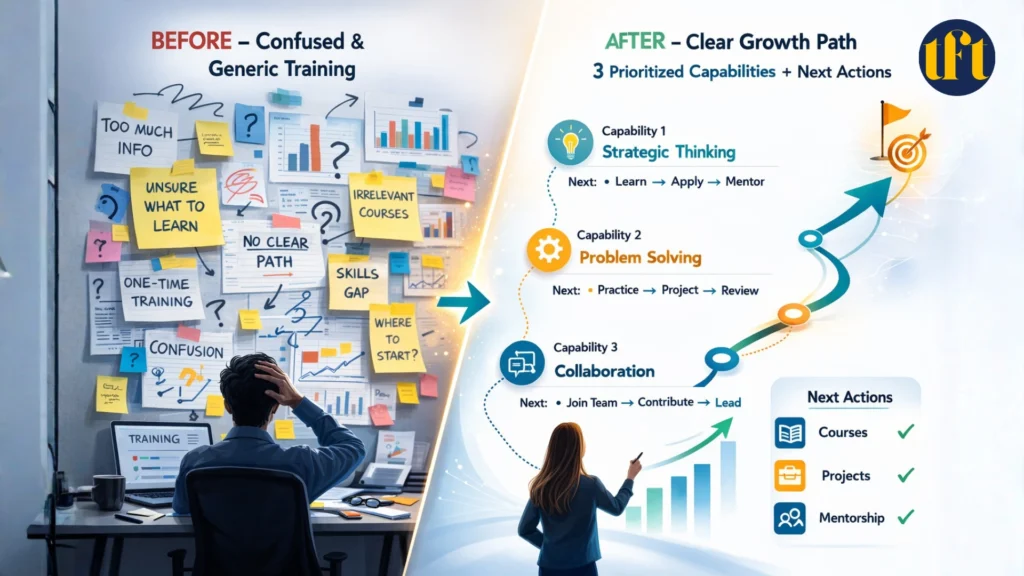
A manager notices a top performer struggling in a new role. Instead of labeling them as “not a fit,” Capabilisense highlights a capability mismatch and suggests a bridge path with specific projects to build missing capabilities. Another team is reorganizing and needs role-to-capability matching to avoid losing critical coverage.
An individual feels stuck and considers a career pivot. Capabilisense identifies adjacent capabilities they already have, recommends a learning pathway, and suggests a low-risk project to validate interest. The result is movement with confidence, not guesswork.
Early Success Stories and Testimonials
Even early prototypes teach you what matters.
In early pilots and conversations, the strongest signal was relief. People said things like, “This finally explains what I do well,” and “This gives me a next step I can actually follow.” Leaders responded to the ability to turn capability gaps into clear actions, instead of another report.
These are not polished case studies yet, but they are the direction. They reinforce that capability intelligence must be understandable, not just accurate.
Building With the Community
Capabilisense is being built in public because the problem is bigger than any one founder.
I believe community input reduces blind spots and improves trust. It also keeps the mission grounded in real needs, not just product theory.
The Role of Community
Community helps shape the capability framework and the user experience.
It provides feedback on language, fairness, usability, and what feels motivating versus judgmental. It also helps ensure the platform serves diverse contexts, not just one industry’s view of success.
If you care about ethical design, transparency, and practical growth, I want you in the room.
Key Principles Guiding the Development of Capabilisense
Principles are not marketing. They are constraints that protect the user.
These are the pillars I return to when making tradeoffs, especially when speed tempts shortcuts.
Clarity Over Complexity
If users do not understand what they see, it will not change behavior.
Capabilisense prioritizes simple explanations, meaningful language, and clear next steps. Complexity should exist behind the scenes, not the user’s face.
Insight Over Data
More metrics do not equal more progress.
Capabilisense focuses on actionable insights that reduce decision fatigue. It aims to translate signals into direction through capability mapping and clear recommendations.
Growth Over Evaluation
Evaluation without support creates fear.
Capabilisense is designed around empowerment over evaluation, with growth paths that feel achievable. The goal is to help people become more capable, not more judged.
Common Mistakes Platforms Make That Capabilisense Avoids
Many platforms make predictable mistakes.
They over-index on ranking systems and under-invest in context. They push generic learning pathways that ignore constraints. They treat capability assessment like a product output instead of a starting point for development.
Capabilisense avoids these by centering context over comparison, prioritizing transparency, and treating progress tracking as core. It also avoids turning people into numbers by building human-in-the-loop workflows and privacy-first defaults.
Expert Tips and Insights for Building a Capability-Driven Platform
If you are building in this space, here are lessons learned building a startup that I wish more teams followed.
Start with a clear capability model tied to outcomes, not job descriptions. Design for decision support, meaning every insight should suggest the next action. Build explainable insights early, because trust is easier to protect than to rebuild.
Also, respect the difference between data and meaning. People will share more and engage more when they feel safe. That requires transparency, fairness, and a product that treats growth as a partnership.
Challenges Along the Way, and I Anticipate
Building Capabilisense means solving difficult problems without losing the human element.
One challenge is avoiding overreach, where a platform claims certainty it cannot guarantee. Another is balancing personalization with privacy, especially when workforce visibility can be misused. There is also the challenge of language: capabilities must be defined in ways that make sense across industries.
Finally, there is adoption. A capability-first approach changes how organizations talk about talent. That shift requires change readiness, not just software.
The Future Landscape of Capability Intelligence
I believe capability intelligence will become as common as analytics dashboards, but far more human.
As work becomes more fluid, organizations will need adaptable systems that support a continuous improvement culture. People will expect tools that help them navigate change with dignity, not tools that label them and move on.
Capability mapping will evolve from an HR function into a shared operating layer for teams, leaders, and individuals.
Encouraging Lifelong Adaptability
Lifelong learning is not a slogan. It is a survival skill.
Capability intelligence can make lifelong learning practical by showing what to learn next, why it matters, and how to practice it in real work. That is how adaptability intelligence becomes a daily habit, not a yearly goal.
Bridging the Future of Work
The future of work requires bridges between talent, strategy, and execution.
Capabilisense is designed to bridge that gap by connecting capability alignment to real outcomes. It supports workforce transformation by making growth visible, measurable, and motivating, without reducing people to rankings.
The Long-Term Vision and Broader Mission
The long-term mission is simple: help people and organizations grow with clarity.
I want Capabilisense to become a trusted layer for strengths discovery, capability development, and better decisions. Not because it is trendy, but because it reduces wasted potential and makes work more humane.
Building for Tomorrow
Building for tomorrow means building systems that adapt.
Capabilisense is designed to evolve with new roles, new tools, and new realities. It should support continuous capability maturity rather than chasing the latest buzzword.
A Vision of Ethical Design
Ethical design is not optional in this category.
Capabilisense will prioritize transparency, privacy-first choices, and responsible AI practices where automation is involved. It will also emphasize user control, so individuals can understand, challenge, and refine how they are represented.
Real-World Impact
Real impact looks like this: people placed where they thrive, teams that execute with fewer bottlenecks, and organizations that transform without breaking trust.
It also looks like fewer wasted training budgets and fewer “transformation theater” initiatives. It is the difference between a platform that measures people and a platform that helps people become more capable.
Why People Search “Why Im Building Capabilisense”
People search for this phrase because they want intent, not just features.
They want to know the founder’s story and the “why I started” motivation. They are trying to understand whether this is a mission-driven startup or just another platform in the talent tech category. They also want to know if the promise is real: does it solve data overload, capability gaps, and the execution gap, or does it add another layer of noise?
Most of all, they want a clear explanation of what capability intelligence is, and whether it can help them personally, as a team, or as a leader navigating change.
Final Thoughts
I’m building Capabilisense because I believe we can do better than static tests, context-free benchmarking, and data without direction. I believe people deserve tools that reveal potential over position and growth over evaluation. And I believe organizations can transform more successfully when they understand capability, not just headcount and titles.
If this resonates, I invite you to join the community, share feedback, and help shape the platform. Capabilisense is a product vision, but it is also a movement toward clarity, dignity, and capability-driven transformation.
FAQs
1. What is Capabilisense?
Capabilisense is a capability intelligence platform designed to map real capabilities in context and transform them into actionable growth paths.
2. Who can use Capabilisense?
Individuals, teams, leaders, and organizations can use it to identify strengths, address capability gaps, and guide development decisions.
3. How is Capabilisense different from career tests?
Career tests often provide static labels, while Capabilisense focuses on context, outcomes, and continuous growth recommendations.
4. What is the main goal of Capabilisense?
Its main goal is to turn capability mapping into a clear direction, helping people grow and helping organizations execute change more effectively.