

If you are new to lacrosse or planning to attend a game, one of the first questions you might ask is simple: how long are lacrosse games? Unlike some sports with fixed durations, lacrosse game length can vary depending on the level of play, league rules, overtime situations, and clock stoppages.
Parents watching youth games, students following college lacrosse, and fans attending professional matches often want to know the typical lacrosse game time and total event duration. Understanding this helps with scheduling, game preparation, and knowing what to expect from kickoff to the final whistle.
In this complete guide, we will explain how long a lacrosse game lasts at the youth, high school, college, professional, and international levels. You will also learn how periods work, what affects game length, and how overtime or delays can extend the match.
How Long Are Lacrosse Games?
Standard Duration of a Regulation Lacrosse Game
A standard lacrosse game typically lasts 48 to 60 minutes of regulation play, depending on the level of competition. Most leagues structure games into four quarters, with each quarter lasting between 10 and 15 minutes.
However, the real duration of a lacrosse game is longer than the official playing time. Clock stoppages, timeouts, halftime breaks, and possible overtime periods extend the total event time.
In most cases, a lacrosse game lasts between 90 minutes and two hours from start to finish. Professional games can sometimes be slightly shorter due to a faster pace and strict clock management.
Typical Regulation Game Times
| Level | Regulation Time | Total Event Duration |
| Youth Lacrosse | 32–40 minutes | 60–75 minutes |
| High School Lacrosse | 48 minutes | 90 minutes |
| College Lacrosse | 60 minutes | 2 hours |
| Professional Lacrosse | 48 minutes | 90–120 minutes |
This table provides a quick overview of average lacrosse game duration across different leagues.
How Many Periods or Quarters Are in Lacrosse?
Most lacrosse games are played in four quarters, similar to sports like basketball or football. Each quarter contributes to the total lacrosse regulation time.
The length of each quarter varies depending on the league.
Typical Lacrosse Quarter Length
| Level | Quarter Length | Total Quarters |
| Youth | 8–10 minutes | 4 |
| High School | 12 minutes | 4 |
| College | 15 minutes | 4 |
| Professional | 12 minutes | 4 |
Quarter breaks between periods usually last 2 to 3 minutes, allowing teams to regroup and coaches to adjust strategy.
Understanding how many quarters are in lacrosse helps explain why game duration varies across levels.
Halftime and Quarter Breaks
Halftime occurs after the second quarter and typically lasts 10 minutes in most leagues. Youth leagues may shorten halftime to around 5 minutes.
Quarter breaks are shorter, usually two minutes, and serve as quick resets between periods.
When calculating how long a lacrosse game lasts, including breaks, these intervals significantly extend the total time spectators spend at the venue.
Lacrosse Game Length by Level of Play
Different leagues structure their games differently to suit player development, skill level, and competition intensity.
Youth Lacrosse Game Length
Youth lacrosse games are shorter because younger players require less physically demanding match durations.
A typical youth lacrosse game length ranges between 32 and 40 minutes of regulation play, usually divided into four quarters of 8 to 10 minutes each.
The total event duration is generally about one hour.
Breaks and Halftime in Youth Lacrosse
Breaks between quarters are usually two minutes, while halftime lasts around five minutes.
These shorter breaks keep games moving quickly and help maintain focus for younger athletes.
Common Youth League Rule Variations
Youth leagues often introduce modifications to support skill development.
Common variations include:
- Shorter quarter lengths
- Running clocks with limited stoppages
- Fewer timeouts
- Simplified penalty enforcement
These adjustments make youth lacrosse easier to manage while still teaching core lacrosse game rules and competition format.
High School Lacrosse Game Length
High school lacrosse games follow more standardized rules and are closer to the structure used in higher levels of competition.
A typical high school lacrosse game time includes four 12-minute quarters, totaling 48 minutes of regulation play.
However, the total event duration is usually around 90 minutes due to stoppages and halftime.
Halftime and Quarter Breaks
High school games usually include:
- Two-minute breaks between quarters
- Ten-minute halftime
This structure ensures adequate rest and strategic planning.
Overtime Rules in High School Lacrosse
If the game is tied at the end of regulation, most high school leagues use sudden-death overtime.
Each overtime period usually lasts four minutes. The first team to score wins immediately.
Multiple overtime periods can extend the real duration of lacrosse games with overtime.
College Lacrosse Game Length
College lacrosse represents one of the most competitive levels of the sport.
A typical college lacrosse game duration is 60 minutes of regulation time, divided into four 15-minute quarters.
This format applies to both NCAA men’s and women’s games, although the pace and rules may differ slightly.
Men’s College Lacrosse Game Length
Men’s NCAA games consist of:
- Four 15-minute quarters
- Two-minute quarter breaks
- Ten-minute halftime
Because of clock stoppages, penalties, and reviews, the total event length can reach two hours or more.
Women’s College Lacrosse Game Length
A women’s lacrosse game duration also totals 60 minutes.
However, gameplay rules such as draw controls and different checking regulations can influence pace and perceived match length.
College Lacrosse Clock Management
Clock management plays an important role in college games.
The game clock stops for:
- Goals
- Penalties
- Timeouts
- Official reviews
These stoppages can extend the total time of a lacrosse game well beyond the regulation period.
Professional Lacrosse Game Length
Professional leagues aim to balance competitive play with entertainment value.
Most professional games last 48 minutes of regulation time, similar to high school games but with a faster pace and more efficient officiating.
Premier Lacrosse League (PLL) Game Duration
PLL games include:
- Four 12-minute quarters
- Two-minute breaks between quarters
- Ten-minute halftime
Because of streamlined broadcast pacing, the PLL lacrosse game length usually stays under two hours.
National Lacrosse League (NLL) Game Duration
The NLL lacrosse game time applies to indoor box lacrosse.
Games consist of:
- Four 15-minute quarters
- Short breaks between periods
- Ten to fifteen-minute halftime
Indoor play tends to be faster, though penalty time can extend overall match length.
Professional Lacrosse Overtime Rules
Professional leagues typically use sudden-death overtime.
Overtime periods last around four minutes, and the first goal immediately ends the game.
Time-Saving Measures Used in Pro Leagues
Professional leagues often implement rules to keep games efficient.
Examples include:
- Faster restart procedures
- Limited coach challenges
- Streamlined penalty enforcement
These measures help ensure professional lacrosse game duration remains predictable for broadcasters and fans.
Women’s Lacrosse Game Length and Rule Differences
Why Women’s Lacrosse Games Can Differ in Length
While the total regulation time often matches men’s lacrosse, gameplay rules differ.
Women’s lacrosse emphasizes:
- Less physical contact
- Different stick checking rules
- More structured defensive zones
These differences can influence game pace and perceived duration.
Historical Changes to Women’s Lacrosse Game Time
Historically, women’s lacrosse used two 30-minute halves instead of quarters.
Modern rule updates introduced four quarters, aligning women’s lacrosse with other levels of play.
These changes improved television broadcasting and standardized lacrosse match rules across leagues.
International Lacrosse Game Length
International competitions follow rules established by the Federation of International Lacrosse.
International Field Lacrosse Game Duration
International field lacrosse games typically last:
- 60 minutes of regulation play
- Four 15-minute quarters
This format mirrors NCAA college competition.
Box Lacrosse Game Length
Box lacrosse, played indoors, also uses four quarters but often includes faster gameplay and more frequent scoring.
Games typically last 60 minutes of regulation time.
Rule Differences in International Play
International matches may include:
- Different substitution rules
- Slightly different penalty enforcement
- Modified overtime formats
These variations influence the international lacrosse game duration and overall pace.
What Can Make a Lacrosse Game Longer?
Several factors can extend the real duration of lacrosse games beyond regulation time.
Overtime Scenarios
If teams are tied after regulation, overtime is required.
Most leagues use sudden-death overtime, where the first goal ends the game.
Multiple overtime periods can significantly extend the total match time.
Injury Timeouts
Player injuries require stoppages to ensure athlete safety.
Medical evaluations and substitutions can add several minutes to the game clock.
Penalties and Foul Reviews
Penalties are a core part of lacrosse game rules.
Officials may stop play to:
- Assess fouls
- Review penalties
- Reset possession
These pauses increase overall lacrosse stoppage time.
Clock Stoppages During Play
The lacrosse game clock often stops for:
- Goals
- Out-of-bounds plays
- Official timeouts
Frequent stoppages make the average lacrosse match duration longer than regulation time.
Weather Delays
Outdoor games are vulnerable to weather interruptions.
Lightning, heavy rain, or unsafe field conditions can delay games until play is safe again.
These lacrosse weather delays are unpredictable but can add significant time.
Additional Time Around Lacrosse Games
The actual experience of attending a lacrosse game includes more than just playing time.
Pre-Game Warmups and Ceremonies
Teams typically arrive 30 to 60 minutes before kickoff.
Activities include:
- Warmups
- Stick checks
- National anthem ceremonies
These events extend the full lacrosse game timeline.

Timeouts and Strategic Breaks
Teams receive a limited number of timeouts to adjust strategy.
Each timeout usually lasts one minute and stops the clock.
Timeouts contribute to the total time commitment for a lacrosse game.
Post-Game Wrap-Up
After the final whistle, teams often engage in:
- Handshake lines
- Coach discussions
- Player interviews
These activities may add another 10 to 15 minutes to the event.
What’s the Total Time Commitment for Players and Fans?
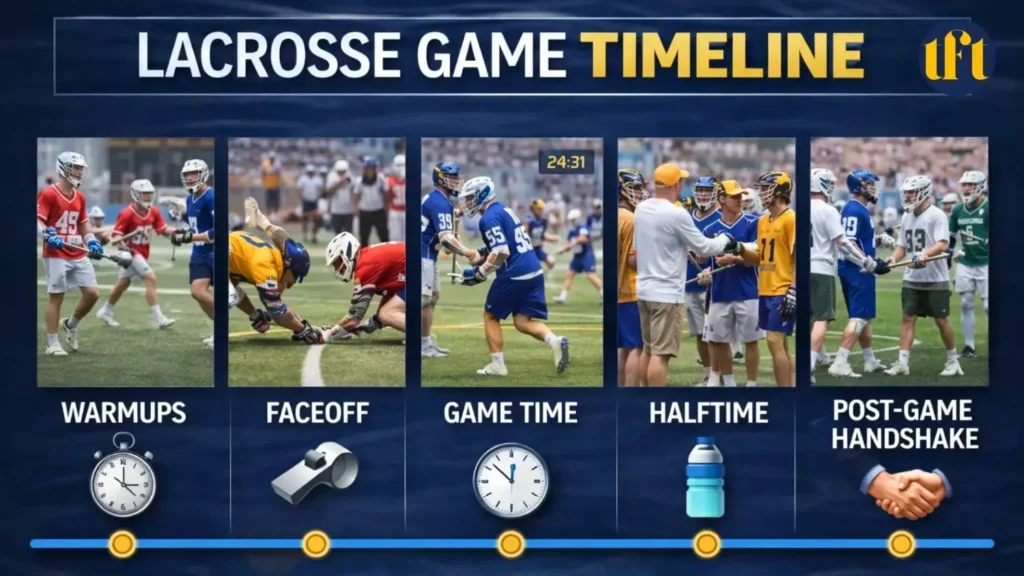
Typical Game Day Timeline
Here is a typical timeline for a college lacrosse game day.
| Event | Approximate Time |
| Player Warmups | 45 minutes |
| Regulation Game | 60 minutes |
| Halftime | 10 minutes |
| Breaks and Timeouts | 15 minutes |
| Post-Game Activities | 10 minutes |
Total time commitment: around two hours.
How Long Fans Should Expect to Stay at a Game
For most fans, attending a lacrosse game requires 90 minutes to two hours.
Professional games may run slightly shorter due to a faster pace and broadcast scheduling.
Youth games are usually completed within about one hour.
Frequently Asked Questions About How Long Are Lacrosse Games?
1. How long is a typical lacrosse game at each level?
Youth games usually last about one hour, high school games about 90 minutes, and college games around two hours, including breaks. Professional matches often fall between 90 minutes and two hours, depending on overtime and stoppages.
2. Does the clock stop during lacrosse games?
Yes. The clock stops for several situations, including goals, penalties, timeouts, and official reviews. These stoppages contribute to the real duration of lacrosse games exceeding regulation time.
3. What happens if a lacrosse game is tied at the end of regulation?
Most leagues use sudden-death overtime. Teams play additional periods until one team scores the winning goal.
4. Why do professional lacrosse games sometimes feel shorter?
Professional leagues emphasize a faster pace and streamlined officiating. This reduces stoppages and keeps the professional lacrosse game length consistent for broadcasts.
5. Are men’s and women’s lacrosse games the same length?
Yes. Both usually last 60 minutes of regulation play at the college level. However, differences in rules and pace may affect the overall perceived game duration.
Final Thoughts on Lacrosse Game Duration
So, how long are lacrosse games? The answer depends on the level of play, league rules, and game conditions.
Most games include 48 to 60 minutes of regulation time, but the total event duration usually ranges between 90 minutes and two hours when breaks, halftime, and stoppages are included.
Understanding the average length of a lacrosse game helps players, parents, and fans plan their schedules and enjoy the experience more fully.
Whether you are attending a youth match, watching NCAA competition, or following professional leagues, knowing how game timing works makes the sport easier to follow and appreciate.